-
Heavy-duty Racking
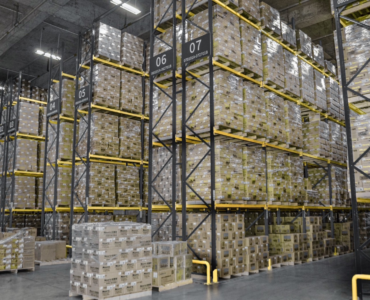
“Heavy-duty racking” is used to store goods on pallets in dedicated storage racks. It mainly consists of standard profile columns, beams, and crossbeams, and is easy to assemble and disassemble without welding. It has an extremely high load-bearing capacity.
The specifications of the materials, including load requirements, rack size, aisle space, and stacker lift height, can be adjusted according to customer needs. As a result, heavy-duty racking is widely used as the foundation for all storage systems.
Features
-
Makes goods easier to store at high levels, increasing space utilization by over 250%.
-
Highly flexible, allowing adjustments to the profile of columns and beams based on load requirements.
-
Paired with handling equipment for convenient and fast access.
-
Makes inventory management easier with clear visibility and easy counting.
-
The space between each layer can be freely adjusted using hooks and diamond-shaped holes.
-
-
Push-back Racking
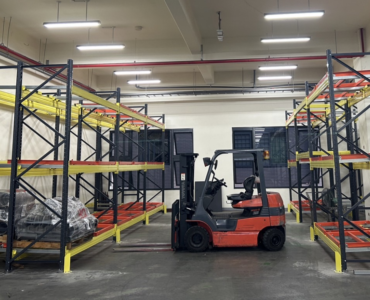
“Push-back racking” combines the high-density storage of drive-in racking while improving its shortcomings. The stacker does not need to enter the rack.
By using a non-powered trolley with inclined tracks (2° or 2.5°), it utilizes the principle of the weight of the goods to automatically slide towards the access point, significantly improving access efficiency and safety.
This racking system is suitable for situations where space costs are high or limited but there is a need to increase storage capacity, such as in high-tech, cold chain, or food industries.
Features
-
Significantly reduces the number of aisles needed for stackers, increasing space utilization by over 30%.
-
The best design for the rack is 2 to 4 pallets deep, making it a high-density storage system.
-
Goods are stored in an advanced first-in, last-out mode, suitable for storing large quantities of a few items.
-
The track is inclined at 2° or 2.5°, which sacrifices some vertical space; thus, the design should not exceed 5 pallets deep.
-
The trolley is designed to compensate for the track incline, enhancing the safety of the racking system.
Features
-
Makes goods easier to store at high levels, increasing space utilization by over 250%.
-
Highly flexible, allowing adjustments to the profile of columns and beams based on load requirements.
-
Paired with handling equipment for convenient and fast access.
-
Makes inventory management easier with clear visibility and easy counting.
-
The space between each layer can be adjusted freely using hooks and diamond-shaped holes.
-
-
-
Bidirectional Shuttle Racking System
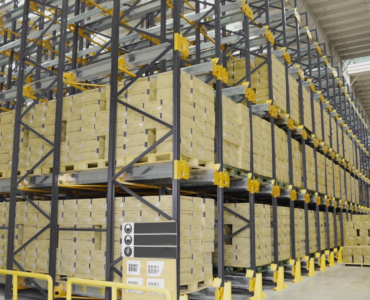
The bidirectional shuttle system uses a shuttle vehicle to semi-automate the transportation of goods within the rack tracks, reducing collisions between the stacker and the racks. Compared to traditional drive-in systems, it greatly increases the rack density, avoiding the risks of rack collapse due to human error and reducing maintenance costs, while improving inefficient access modes.
Features
-
Enhances operational safety by reducing collisions between racks and stackers, preventing rack collapse.
-
Reduces the aisle space needed for stackers, achieving high storage density and high space utilization.
-
High inbound and outbound efficiency, requiring operations only at the access points, increasing work efficiency.
-
Flexible storage methods, allowing for design planning in a first-in, first-out or first-in, last-out mode.
-
Suitable for industries with large quantities and high turnover of a small variety of goods.
-
-
Drive-In Racking
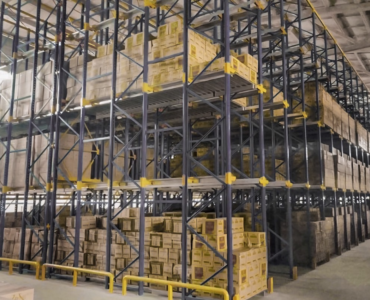
“Drive-in racking” is a special system where racks are arranged side by side and interconnected, offering high storage efficiency, and is suitable for the storage of goods with few varieties but large quantities. This racking system allows a stacker to drive into the rack to access goods, but its structural stability is weaker, so the racks should not be too high, usually controlled within 10 meters. It is suitable for industries with high storage space costs, as the storage cost is relatively low.
Features
-
Forklifts share the aisle with goods for access, achieving high site utilization.
-
Goods are stocked from the inside out and picked from the outside in, following a first-in, first-out (FIFO) method.
-
Site utilization is based on 60%, with the effective space utilization rate increasing by over 400%.
-
Ideal for periodic bulk operations and warehouses with low frequency of material access, such as raw material or operational warehouses.
-
Since forklifts must drive into the aisle, the rack structure is less stable, and the design height should not be too high.
-